
Course accreditation is the process of assessment and official approval of a course plus its associated qualification, to indicate that the course meets particular requirements defined by the VQA. The Course Accreditation process ensures that the design and the rules and regulations of a course meet quality standards. An application for accreditation is judged against the Standards for course accreditation in the Vanuatu Quality Assurance Framework.
Providers must be registered before they can apply for course accreditation.
Having a course accredited does not mean that the provider can deliver the course. A provider can only deliver an accredited course if it has Approval to Deliver this course. Accreditation is applied for by a registered provider, but an accredited course can in principle be delivered by any provider, as long as this provider has the appropriate resources.
The application process for course accreditation consists of two steps:
To apply for accreditation of an overseas course, go to: Accreditation of Overseas Courses.
Once a course is accredited, the provider still needs to apply for Approval to Deliver the course, if they want to deliver the course as well. This is not part of the Course Accreditation process. For information on this process, see:
Also after a number of years, the Course Accreditation will expire and will need to be renewed. For more information, see:
What is a Training Package?
A Training Package describes a range of nationally approved units of competency, as well as guidelines how these units can be packaged into a vocational course at a particular level, which is endorsed by industry and meets the Vanuatu Qualifications Framework (VQF) and Vanuatu Quality Assurance Framework (VQAF) requirements for courses and qualifications. They also include support and guidance for delivery of the designed course.
VQA has endorsed Training Packages for a wide range of industries.
Each Training Package:
- provides an approved, consistent and reliable set of units of competency for training, recognizing and assessing people's skills, and may also have optional support materials;
- encourages the development and delivery of flexible training which suits individual and industry requirements;
- Encourages learning and assessment in a work-related environment which leads to verifiable workplace outcomes; and,
- enables nationally recognised qualifications to be awarded through direct assessment of workplace competencies
Training Package Endorsed Components
Training Packages consist of two types of components: compulsory components that are endorsed by the VQA, and optional support materials that are not endorsed.
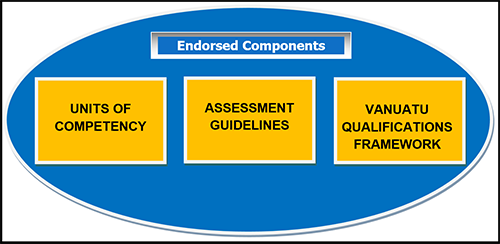
The nationally endorsed components include the Units of Competency, the Assessment Guidelines and the Vanuatu Qualifications Framework (VQF). These form the basis of training and assessment in the Training Package and as such, they must be used.
Training Package Support Materials or Non-endorsed components
The endorsed components of Training Packages are complemented and supported by optional materials that provide for choice in the design of training and assessment to meet the needs of industry and learners.
Training Package support materials or non-endorsed components can relate to single or multiple units of competency, an industry sector, a qualification or the whole Training Package. They tend to fall into one or more of the categories illustrated below.
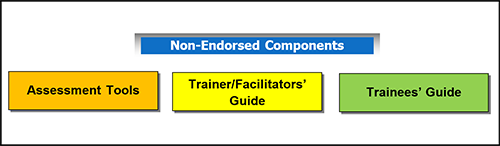
Training Package support materials are produced by a range of stakeholders such as Registered Providers, individual trainers and assessors, private and commercial developers and Government agencies.
Where such materials have been quality assured through a process of 'noting' by the VQA, they display an official VQA logo.
Subcategories
Provider details
Registered Providers
This list is sorted alphabetically. You can click on any of the PSET Providers' name to see more details.
Course details
Accredited Courses
The list of courses is quite long, so we are showing only 25 on each page. If you have a good Internet connection, you can select to see more than the 25 courses per page. Or you can go to the bottom of this page and click to go to the next section of the list.
The list is sorted first by area (like Agriculture, Aquaculture, Building and Construction, Business, etc), then by level (Certificate I, Certificate II, ...) and finally by specialization. The Courses are listed in alphabetical order.