

Home

For Providers

For Learners

For Industry

Publications

About Us

Search our Site

 
IMPLEMENTATION PROGRESS OF THE National Human Resource Development Plan
-------------------------------------------------------------------------------------------------

Group 26755, Grouped object

Background on NHRDP 2030 

The Government of Vanuatu continues to recognize the National Human Resource Development Plan (NHRDP 2030) as a national priority and a critical enabler for the successful implementation of the National Sustainable Development Plan (NSDP 2016–2030), commonly known as The Pipol Plan.  

During the 2023 Pipol’s Summit held in Port Vila, the Government acknowledged that overall progress in implementing the NSDP has been relatively slow. This has been largely attributed to the absence of a sufficiently skilled and appropriately qualified workforce to drive national development objectives. 

To address this gap, the Vanuatu Qualifications Authority (VQA) has been mandated by the Vanuatu Council of Ministers (COM) to guide workforce development across the country through the coordination and implementation of the NHRDP 2030. The Plan seeks to ensure that Ni-Vanuatu are equipped with relevant skills, knowledge, and competencies to contribute effectively to domestic development priorities, while also responding to growing demand in international labour markets. 

Given the characteristics of Vanuatu’s labor market, the NHRDP provides a strategic guide for realigning investment in human resource development. It complements the National Sustainable Development Plan 2020–2030 by ensuring that resources allocated to Post-School Education and Training (PSET) are used more efficiently and effectively, in line with national workforce needs. 

The Plan identifies priority skills on the demand side of the labor market across both public and private sectors, while analyzing labor supply by assessing the capacity of the education and training system to meet this demand. 

  • The NHRDP serves as the Government’s central workforce planning tool to: 
    Identify current and future workforce needs across all sectors of the economy. 
  • Guide policy decisions and public investment in education, training, and human capital development. 
  • Ensure that skills development supports national development priorities, economic resilience, and inclusive growth; and 
  • Strengthen coordination between Government, training institutions, employers, and development partners. 

A whole-of-government, whole-of-nation approach 

The NHRDP is not owned by a single institution. It is a whole-of-Government and whole-of-nation initiative, implemented through close collaboration among line ministries, statutory bodies, provinces, the private sector, and civil society. 

This approach ensures that: 

  • Workforce planning reflects real economic and community needs; 

  • Skills development supports both public service delivery and private sector growth; and 

  • National development is driven by a skilled, adaptable, and future-ready workforce. 

The Vanuatu Qualifications Authority (VQA) role in the NHRDP 

Under its mandate from the Council of Ministers (COM), the Vanuatu Qualifications Authority (VQA) is responsible for coordinating the implementation of the NHRDP 2030. VQA leads and or coordinates the identification and analysis of priority occupations and ensures that qualifications, training programmes, and skills pathways are aligned with nationally recognized standards and Government priorities. 

Through this role, VQA provides Government with reliable, evidence-based information to inform decisions related to PSET training, tertiary education, and scholarship allocations, ensuring coherence between workforce demand, skills supply, and public investment. 

NHRDP 2030 progress and achievements 

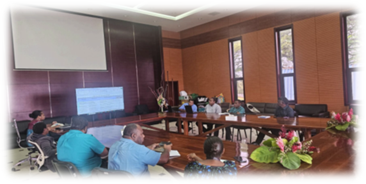
As part of the national rollout of the NHRDP 2030, VQA has engaged with key stakeholders to ensure broad and inclusive national participation in identifying and addressing workforce development priorities. 

To date, consultations on priority occupations have been conducted with all Government Ministries. This constituted the first phase of NHRDP implementation and provided a strong foundation for identifying sector-specific workforce needs or priority qualifications. 

The VQA technical team compiled and analyzed outputs from these ministerial mapping exercises to determine priority qualifications required across sectors. This process has enabled VQA to advise Government with precise advice on workforce requirements, ensuring alignment with sectoral priorities and national development objectives. 

NHRDP priority list of occupations 

The Vanuatu Qualifications Authority is pleased to present the Priority Occupations identified under the NHRDP 2020–2030. All ministries and sectors were invited to identify and submit their priority occupations and workforce requirements, ensuring that: 

  • No sector is excluded from the national framework. 

  • Cross-cutting skills (including ICT, business, administration, management, finance, and climate resilience) are considered across sectors; and 

  • The NHRDP Priority List of Occupations remains a living document that can be updated as emerging needs arise. 

The Priority Occupations List across all sectors, has been endorsed by the VQA Board. 

NHRDP priority list of qualifications 

Based on the priority occupations submitted by all ministries, the VQA technical team identified and consolidated the corresponding qualifications required for each sector into a single national list. 

A comprehensive data-cleaning exercise was conducted to remove qualifications already registered in the VQA database, thereby avoiding duplication. The consolidated list of priority qualifications across all sectors has been endorsed by the VQA Board. 

Categorization of NHRDP priority qualifications  
With the identification of priority qualifications completed, the focus now shifts to qualifications development and delivery. With support from relevant VQA units, qualifications have been categorized into: 

  1. Qualifications within VQA’s scope – to be developed, accredited, delivered, and regulated under the VQA framework; and  

  1. Qualifications outside VQA’s scope – requiring alternative arrangements, partnerships, or scholarship-based pathways.  

Rectangle 1, Textbox

Alignment with 2026 Government Scholarship Priorities 

For the 2026 Government Scholarship Awards, priority sectors have been confirmed as Agriculture, Health, Education, and Trade & Tourism, in alignment with the National Human Resource Development Plan (NHRDP).  

To support evidence-based and nationally aligned scholarship decisions, the Vanuatu Qualifications Authority (VQA) has been requested to provide the list of 2026 NHRDP priority qualifications related to these 4 sectors, as approved by the VQA Board.  

These priority qualifications have assisted the Scholarship Office when deliberating applications and ensuring that 2026 awards: 

  • Align with national and NHRDP priority qualifications. 

  • Target skills shortages and workforce demand in the four priority sectors. 

  • Have a clear and justified basis for allocation across fields and levels of study. 

  • Maximize the impact of public investment in education and skills development; and 

  • Support applicants in selecting relevant and high-impact fields of study. 

Way Forward 

As the NHRDP is intended to address national workforce needs, VQA plans to extend the current mapping exercise on priority occupations beyond the central government to include provincial administrations, the private sector, State-Owned Enterprises (SOEs), statutory bodies, and civil society organizations. This expanded approach will ensure that the NHRDP reflects skills and employment needs across all levels of the economy. 

Once the national workforce mapping is completed, VQA will formally report to the Council of Ministers (through the VQA Board) priority workforce requirements for Government and the broader labour market. Subject to Government endorsement, the Council of Ministers may direct all PSET institutions, tertiary providers, and relevant stakeholders to align their policies, programmes, and training delivery with the NHRDP findings. 

This end-to-end alignment—from policy and planning to program delivery—ensures that education and training initiatives directly support skills and qualifications identified as critical under VQA’s COM mandate. 

VQA is encouraged by the progress achieved to date, which directly supports the Ministry of Education and the Scholarship Commission in their deliberations for the 2026 scholarship awards. Work is ongoing to update the NHRDP webpage as remaining submissions are yet to be consolidated. 

The Vanuatu Qualifications Authority, through the NHRDP Coordinator, sincerely thanks all stakeholders for their continued support and collaboration in advancing national human resource development priorities in Vanuatu.